- Software Gestor para Aquicultura
- Falar pelo WHATSAPP
- contato@despesca.com.br



8 Techniques to Improve Feed Conversion in Your Aquaculture

10 Financial Mistakes in Aquaculture That Can Sink Your Business
09/10/2025
Aquaculture Production Cycle Planning: The 10 Most Common Mistakes and How to Avoid Them
13/10/2025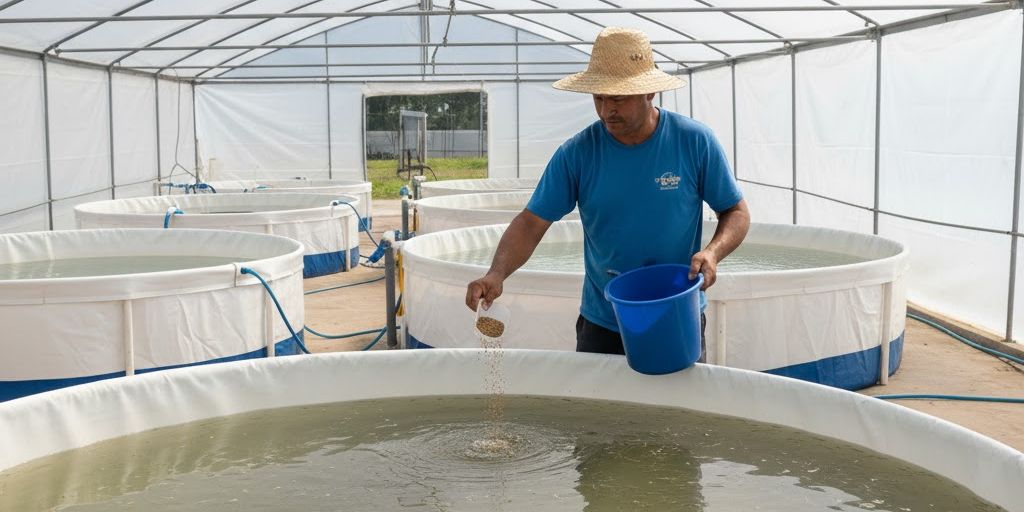
The pursuit of maximum efficiency is a constant in modern aquaculture. Among the various performance indicators, the Feed Conversion Ratio (FCR) stands out as one of the most critical, directly impacting the operation’s profitability. After all, feed represents the largest portion of production costs. Therefore, understanding how to improve feed conversion is not merely a technical adjustment, but a strategic decision for the business’s sustainability.
A low feed conversion indicates that the animals are making the most of the nutrients provided, efficiently transforming them into biomass. Conversely, a high FCR points to feed waste and, consequently, financial resource waste. This article presents eight fundamental techniques to optimize this index in your fish or shrimp farming.
What is the Feed Conversion Ratio (FCR)?
Before detailing the techniques, it is crucial to solidify the concept. FCR is the relationship between the amount of feed supplied and the animals’ weight gain. The formula is simple:
FCR = Quantity of Feed Supplied (kg) / Biomass Gain (kg)
The goal of every producer is to achieve the lowest possible FCR, ideally close to 1. This indicates that for every kilogram of feed, the animal gained approximately one kilogram of weight.
8 Essential Techniques to Improve Feed Conversion
FCR optimization is a multifactorial process. Thus, the combined application of the following practices results in significant and consistent improvements.
1. Feed Quality
The foundation of good conversion begins with feed selection. High-quality feeds, with highly digestible ingredients and an appropriate nutritional profile for each species and life stage, are essential. Furthermore, correct storage in a dry and airy place prevents nutrient loss and fungal proliferation, ensuring the product maintains its original characteristics.
2. Feeding Strategy
Providing the correct amount of feed, distributed in portions throughout the day, enhances nutrient utilization by the animals’ digestive system. The use of automatic feeders can increase efficiency by standardizing feeding times and quantities, reducing waste and feeding stress.
3. Water Quality Monitoring
Suboptimal water parameters cause stress in animals, leading them to reduce feed consumption or metabolize it incorrectly. Low dissolved oxygen levels, for example, drastically decrease appetite. Similarly, ammonia and nitrite spikes affect health and, consequently, conversion capacity.
4. Health and Biosecurity
Sick or parasitized animals divert energy, which would be used for growth, to fight pathogens. Consequently, appetite decreases and feed conversion worsens. A robust biosecurity program is not a cost but a direct investment to improve feed conversion and protect production.
5. Adequate Stocking Density
Overcrowded ponds generate excessive competition for food and increase social stress. This condition not only impairs animal welfare but also leads to less efficient feed conversion, as not all individuals can feed adequately.
6. Adoption of Feeding Tables
The use of feeding tables, provided by feed manufacturers or developed by technicians, is a crucial starting point. These tables must be adjusted based on water temperature and, especially, on consumption observations and biometry results.
7. Biometrics and Constant Adjustments
Performing periodic biometrics is fundamental. Without knowing the average weight and total biomass of the pond, it is impossible to calculate the correct amount of feed to be supplied. Adjusting the feed offer based on real growth data prevents both underfeeding, which delays the cycle, and overfeeding, which increases FCR and deteriorates water quality.
8. Quality Genetics
The choice of post-larvae or fingerlings of good genetic origin is a determining factor. Genetically superior animals tend to exhibit faster growth rates and, inherently, a better ability to convert feed into body mass.
The Role of Technology in FCR Optimization
Controlling all these variables manually can be complex and prone to errors. This is where technology becomes an indispensable ally. Management software allows producers to record and analyze data centrally.
With a management system, it is possible to:
- Control feed stock and consumption per pond.
- Record biometry results and automatically adjust feeding tables.
- Maintain a detailed history of water quality parameters, correlating them with performance.
- Calculate FCR in real-time, allowing for immediate corrective actions.
In summary, the decision to improve feed conversion involves adopting good management practices and intelligently using data. By integrating technology into daily management, the producer transforms information into precise actions, optimizing costs and maximizing the productivity of their farm.