- Software Gestor para Aquicultura
- Falar pelo WHATSAPP
- contato@despesca.com.br



Aquaculture Production Cycle Planning: The 10 Most Common Mistakes and How to Avoid Them

8 Techniques to Improve Feed Conversion in Your Aquaculture
10/10/2025
Aquaculture Cost Spreadsheet: The Definitive Guide to Not Missing Any Expense
16/10/2025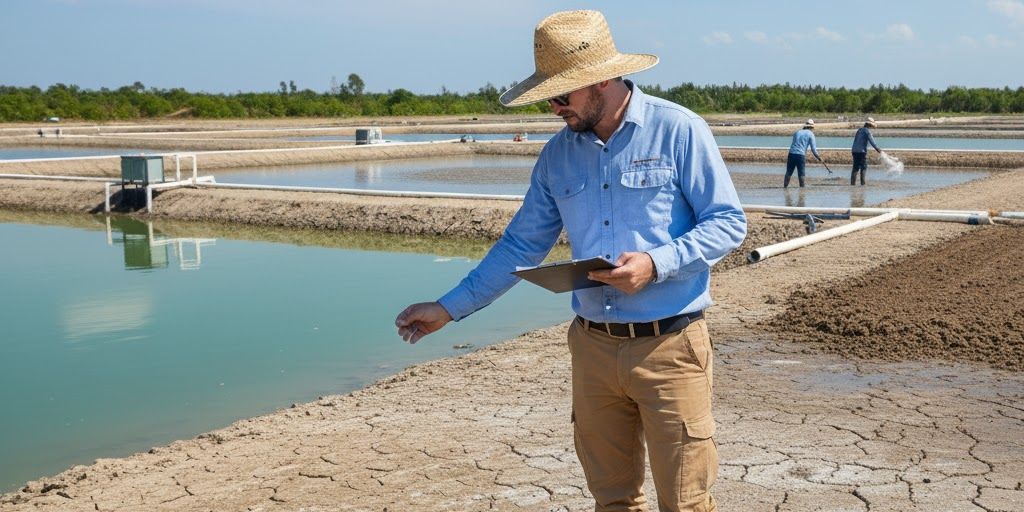
Success in aquaculture, whether raising shrimp or fish, is directly linked to meticulous Aquaculture Production Cycle Planning. Many producers, however, end up making recurring mistakes that can compromise productivity, animal health, and consequently, business profitability. Neglecting this initial phase is a recipe for facing difficulties that could easily be avoided.
This article details the 10 most common mistakes in the production cycle planning and presents practical and technical solutions to help you anticipate problems and ensure a successful harvest.
1. Inadequate Water Quality Analysis at the Source
One of the most primary, yet frequent, mistakes is the lack of a careful analysis of the water supply source. Parameters such as pH, alkalinity, hardness, ammonia, nitrite, and the presence of heavy metals are crucial and must be known before stocking begins.
How to avoid: Perform a complete physical-chemical and microbiological analysis of the incoming water. For shrimp producers, for example, salinity and ionic balance are vital from day one. Continuous monitoring tools, although an initial investment, can save resources by preventing mass mortalities. Furthermore, knowing water quality is fundamental for pond management, a topic we address in other articles.
2. Choosing Low-Quality Post-larvae or Fingerlings
The genetics and health of the animals at the beginning of the cycle are decisive for the final outcome. Acquiring shrimp post-larvae (PLs) or fish fingerlings from uncertified laboratories or suppliers with a poor track record is an immense risk. Low-quality animals can exhibit uneven growth, increased susceptibility to diseases, and poor feed conversion ratio.
How to avoid: Seek suppliers with good references, who offer health certificates, and if possible, visit their facilities. For shrimp PLs, check their activity, size uniformity, and absence of deformities. For fingerlings, observe their swimming behavior, response to stimuli, and gill health.
3. Lack of Nutritional and Feeding Planning
Feed costs represent the largest portion of production expenses. An inadequate feeding plan, whether due to overfeeding or underfeeding, directly impacts zootechnical performance and water quality. The mistake lies in not adjusting the quantity and type of feed according to the pond’s biomass, development stage, and environmental parameters.
How to avoid: Use feeding tables as a starting point, but adjust them based on weekly or bi-weekly biometrics. Efficient Aquaculture Production Cycle Planning includes using feeding trays to monitor consumption and adjust feed offerings, preventing feed waste that, in turn, decomposes and degrades water quality, increasing nitrogenous compound levels.
4. Incorrect Stocking Density Sizing
The temptation to increase stocking density to maximize profit per area is strong, but dangerous. Overpopulating a pond without adequate aeration and water exchange support leads to rapid deterioration of water parameters, animal stress, and disease outbreaks.
How to avoid: Stocking density must be compatible with your system’s carrying capacity. This depends on the pond volume, water exchange rate, and, fundamentally, aeration capacity. Systems with paddlewheel aerators or bottom aeration allow for higher densities but require much more rigorous monitoring.
5. Negligence with Biosecurity
Biosecurity is not a luxury; it’s a necessity. The lack of protocols for equipment disinfection, farm access control, and effluent management opens the door to the entry and spread of pathogens, such as the White Spot Syndrome Virus (WSSV) in shrimp farming.
How to avoid: Implement sanitary barriers, such as wheel dips and footbaths at the farm entrance and cultivation areas. Avoid sharing equipment between ponds without proper disinfection. Furthermore, develop a quarantine plan for the arrival of new juvenile forms.
6. Lack of an Emergency Action Plan
What if the power goes out and the aerators stop working? What if there’s a sudden drop in oxygen during the night? The absence of a contingency plan for such situations can result in the loss of an entire cycle in a matter of hours.
How to avoid: Always have a power generator in perfect working order with sufficient fuel. Maintain emergency stocks of products for parameter correction, such as lime for pH and probiotics. Train your team to act quickly in adverse scenarios, following a clear protocol.
7. Insufficient Parameter Monitoring
Modern aquaculture is data-driven. Limiting monitoring to a single daily oxygen measurement is insufficient. Parameters such as temperature, pH, and ammonia can fluctuate significantly throughout the day and night, and these variations cause chronic stress in the animals. Good Aquaculture Production Cycle Planning relies on accurate data.
How to avoid: Conduct dissolved oxygen and temperature measurements in the early morning (worst-case scenario) and late afternoon (best-case scenario). Monitor ammonia, nitrite, and alkalinity weekly. The use of multiparameter probes can optimize this work and provide a more complete overview of pond health.
8. Absence of Detailed Zootechnical Records
“What is not measured cannot be managed.” The lack of accurate notes on biometrics, feed consumption, mortalities, parameter measurements, and management performed prevents the identification of trends, course correction, and learning between cycles.
How to avoid: Use spreadsheets or management software to record all relevant cycle information. Data such as apparent feed conversion ratio (AFCR) and survival rate are key performance indicators that can only be calculated with detailed records.
9. Inadequate Pond Bottom Preparation During Off-Season
Managing the pond bottom between cycles is as important as managing it during production. Accumulated organic matter (feed remnants, feces, and exoskeletons) decomposes, creating an anoxic environment and releasing toxic gases that can harm the subsequent cycle.
How to avoid: After harvest, the pond should be completely drained and the bottom exposed to the sun (drying). Liming is an essential practice for disinfection and pH correction of the soil. Mechanical removal of the superficial sludge layer is also recommended, especially in feeding areas.
10. Lack of Harvest and Commercialization Planning
It is pointless to produce high-quality fish or shrimp if there is no clear plan for their sale. Harvesting without a defined buyer or adequate transportation logistics can lead to product quality loss and disadvantageous negotiations.
How to avoid: Aquaculture Production Cycle Planning must conclude with a commercialization strategy. Initiate contact with potential buyers weeks before the anticipated harvest date. Plan logistics, including labor, ice, and transport, to ensure the product reaches its destination with maximum freshness and quality.